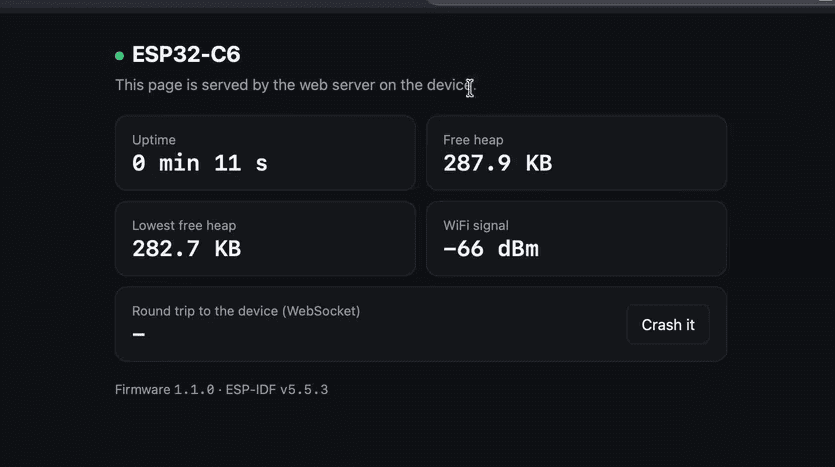
The team behind Pinscope had a problem. They needed an ESP32 to stay securely connected to a server, but they didn’t have enough spare RAM on the chip to do TLS, what with everything else going on. Thus, they whipped up a useful workaround to get remote access on an ESP32 without TLS. The team noted they didn’t need the general functionality of TLS. See, TLS is great for connecting any client and server securely with certificates, but it’s a bit heavy when you’re working with a device that only needs to connect to one server for maintenance. The team decided the device just needed to ID whether it was talking to the real server, it must ensure credentials are sent over the wire encrypted, and messages should not be able to be replayed, read, reordered, or otherwise changed while in transit. The solution to this problem was the Noise protocol. Specifically, Noise_NK_25519_ChaChaPoly_SHA256, where the server uses a static key which the device knows in advance. Since only the holder of the server’s private key can properly finish a handshake, the device knows it’s talking to the real server, and the entire handshake takes just 0.3 seconds on the ESP32, with just 100 bytes sent over the wire. The results are compelling. The ESP32 needed 23.6 KB of RAM to stay connected via TLS, while this dropped to just 9.4 KB using the Noise protocol. If you need to lighten the burden on a remotely-connected ESP32, you might find this work very useful. Files are on Github for the curious.
ESP32 Remote Access Done Light
The team behind Pinscope had a problem. They needed an ESP32 to stay securely connected to a server, but they didn’t have enough spare RAM on the chip to do …read more
Editor
Nov 28, 2026 · 2 min read
Source: Zoe Skyforest
From other categories

Mobile Development
Deal: Black Friday brings even bigger discounts for the Galaxy Z Fold8 and Galaxy Z Fold8 Ultra
32m ago·1 min

AI & Machine Learning
Code-driven AI illustrations are more useful than images from dedicated image models
5h ago·5 min

Operating Systems
NixOS 26.11 “Zokor” Released with GNOME 51, KDE Plasma 6.8, and Linux 7.3
7h ago·1 min
Security
pCloud Password Manager Hit by Cyber Attack Involving Email Address Exposure and Login Attempts
9h ago·1 min

Databases
Ryan Lambert: Postgres 19 Upgrade from Postgres 15
18h ago·1 min

Programming Languages
Announcing Rust 1.100.1
2d ago·2 min