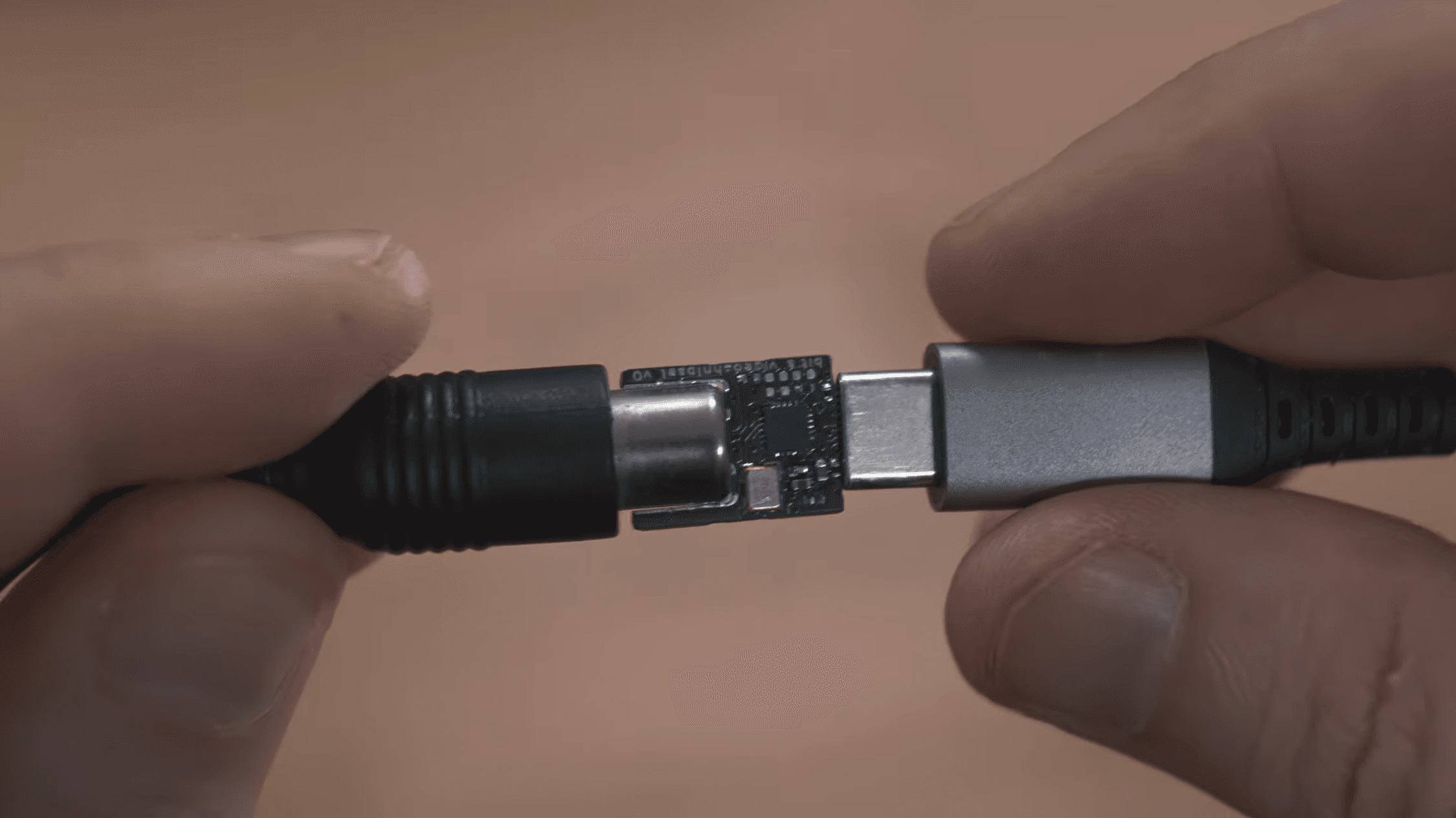
Considering how powerful they’ve become and how many other tasks they’ve been repurposed for, it’s easy to forget that a GPU’s primary purpose is to generate graphics. With this definition in mind, and accepting a somewhat lower standard of performance, it’s entirely possible to build a twenty-cent GPU, as [bitluni] demonstrated with this USB to analog video converter. The converter is built into one tiny PCB with only one active component, a CH570 microcontroller, and a few passive components. Not only is the USB-C connector made out of the PCB itself, the analog RCA connector is also: the PCB is designed with several copper-plated cutouts which let it plug into a female RCA port. There is a quirk with this approach, though: many RCA ports apparently only have one wire to make contact with the internal pin, making this somewhat sensitive to orientation. Of the passive components, the most important was a crystal oscillator to keep the generated signal in sync with the display’s refresh rate; timing was this project’s main constraint. To keep up with the necessary rate, all high-speed operations had to be done with SRAM; an odd performance drop turned out to be caused by the compiler using flash memory. The actual analog signal is generated with PWM. The device appears as a USB CDC device, and can display greyscale text and rudimentary graphics; [bitluni] wrote a program to use it as a serial terminal. Interestingly, when the TV he was using as a display was in wireless reception mode, it was able to pick up on the PWM signal transmitted by a jumper wire. This inspired [bitluni] to search for more transmission options; it turns out that with SPI and overclocking, the system might be able to transmit a PAL colour signal. This isn’t [bitluni]’s first time getting video out of an unlikely microcontroller; he’s also driven VGA with an ESP32. On a bit of a larger scale, he’s also built several coprocessors out of microcontroller clusters.
Building a Single-Chip USB GPU
Considering how powerful they’ve become and how many other tasks they’ve been repurposed for, it’s easy to forget that a GPU’s primary purpose is to generate graphics. With this definition …read more
Editor
Nov 22, 2026 · 2 min read
Source: Aaron Beckendorf
From other categories

Operating Systems
High Tide (Linux TIDAL client) adds support for DLNA, Chromecast
1h ago·1 min

Databases
Mats Kindahl: Building a Table Access Method, Part 9: UNLOGGED tables and surviving a restart
3h ago·20 min

Security
A brief history of syslog timestamps, (Sun, Nov 22nd)
4h ago·4 min

AI & Machine Learning
Meta ads is now available in AWS Quick
20h ago·7 min

Programming Languages
JavaOne 2027 & Java 28 Value Objects - Inside Java Newsletter
2d ago·1 min

Mobile Development
Expanding Android developer verification in 2027
4d ago·1 min