An intrepid developer has deleted their Linux OS and coded a tiny assembly language bare-metal bootable alternative to run LLMs. The result is a super-fast standalone system that starts in milliseconds and runs LLMs up to 54% faster. Moreover, Alexey Fateev, AKA alesha-pro on GitHub, has shared his Bare-Metal Bootable Qwen3-0.6B OS in 24 KB of Pure Assembly for other enthusiasts to code-tweak and test.I deleted Linux completely, baked Qwen3-0.6B into a 24 KB pure x86-64 assembly OS, and it runs up to 54% faster than native Linux llama.cpp.The entire Multiboot OS binary (asm-llm-os.elf) is 24,252 bytes, written from scratch without Linux, Windows, C, Rust, or libc. It boots in 74 to 94 ms straight into 64-bit Long Mode, wakes every CPU core over APIC, maps the 614 MiB Q8_0 weights directly from physical RAM, and drops you into a live multi-turn KV-cache chat over VGA, PS/2 keyboard, and serial.I ran head-to-head CPU benchmarks against llama.cpp (Q8_0, -ngl 0) on the same AMD EPYC 7642:- 1 thread hits 23.67 tok/s vs 16.63 (+42%)- 4 threads hit 78.89 tok/s vs 51.08 (+54%)- 8 threads hit 118.08 tok/s vs 80.79 (+46%)- 16 threads hit 134.94 tok/s vs 103.03 (+31%, 136.6 peak)On a diskless 0 GB Proxmox VM (2014 12-core Intel Xeon E5-2670 v3, 2 GiB RAM), it boots straight to the prompt in under 5 seconds (95 ms kernel boot) and runs live out of RAM at 78 tok/s decode and up to 111.5 tok/s prefill, with a hybrid BIOS+UEFI ISO builder included too. Output stays bit-exact across thread counts and matches all 64 greedy tokens against PyTorch FP32 (0.99965 cosine).The 14.7 KB Linux ELF build (FAST_Q8=1 INT8xINT8 AVX2+F16C) also beats llama.cpp by 18% to 36% from 1 to 40 threads, and booting bare metal with 2 MiB huge pages squeezes out another 10% on top.Repo, ISO builder, and Proxmox setup guide are in the reply below.November 25, 2026The compact size of this Multiboot OS binary (asm-llm-os.elf) is remarkable. Weighing in at just 24KB (24,252 bytes), it makes modern operating systems seem gargantuan. However, one must remember that the legendary Commodore 64 worked off a smaller 20KB ROM, which included not only the kernel but also a BASIC interpreter and a character generator. Fateev says that his Multiboot OS with modern SMP support was written from scratch without Linux, Windows, C, Rust, or libc. Users interact with the new OS via its support for 80x25 character color VGA displays, PS/2 keyboards, and serial communications. Such is the purposeful efficiency of this hand-written NASM assembly language project that it can boot in 74-94 milliseconds directly to its multi-turn chat interface. You're ready to chat with your LLM in the blink of an eye. While the OS and its carefully honed UI use only a tiny portion of the computer's resources, the OS loads Qwen3-0.6B Q8_0, which weighs in at 649MB. That's something of a lightweight LLM, as many of you will be aware, but it is roughly 28,000 times bigger than the OS that references it. That's good, as you bought your computer to run applications and games – not for running an OS – didn't you?Turning to performance, this is another area where Fateev's standalone asm-llm-os.elf excels. In some head-to-head benchmarks of the compact new OS vs. the previous Linux install running the same LLM via llama.cpp, the pure assembly-coded OS was up to 54% faster. On the dev's AMD EPYC 7642 system, "4 threads hit 78.89 tok/s vs 51.08 (+54%)." That is the best result, and therefore highlighted, but is not a crazy outlier figure, with even the most modest performance uplift charted at +31% (when using 16 threads). If you are interested in testing this project, Fateev has shared the full MIT source, ISO builder, and a setup guide at github.com/alesha-pro/llm.asm. Also, if bare-metal operation isn't required, you can test out the Linux-hosted version, which delivers the same basic asm-llm inference binary in just 14KB. That's because 10KB can be saved by removing the code required to boot the system, initialize the processor, keyboard, and monitor I/O, etc.
AI enthusiast deletes Linux for a 24KB pure assembly OS that boots in 74 milliseconds
An intrepid developer has deleted their Linux OS and coded a tiny assembly-language bare-metal bootable alternative to run LLMs. As well as drastically cutting resource use, it seems to work far faster.
Editor
Nov 28, 2026 · 5 min read
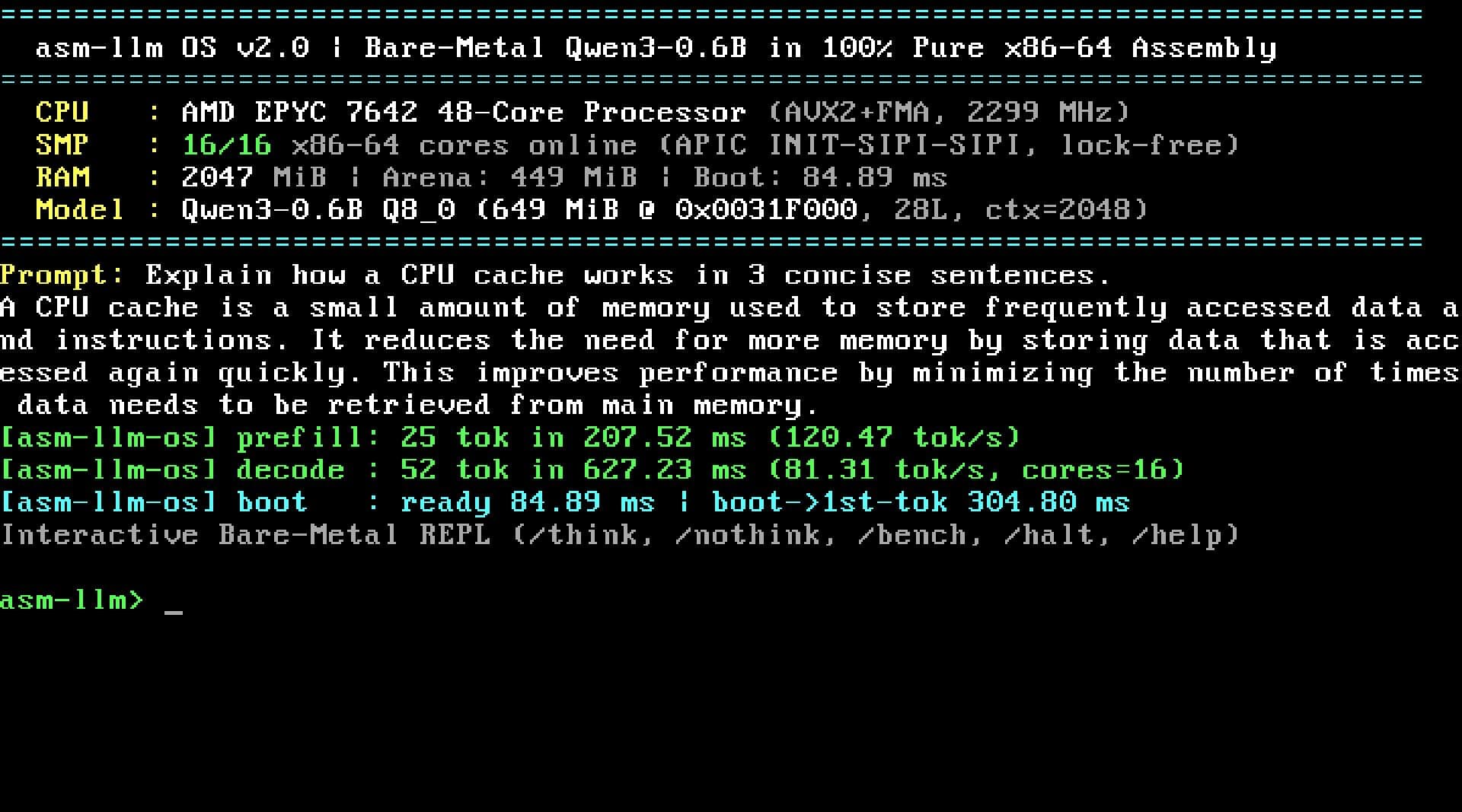
Source: Mark Tyson
From other categories

Mobile Development
Deal: Black Friday brings even bigger discounts for the Galaxy Z Fold8 and Galaxy Z Fold8 Ultra
34m ago·1 min

AI & Machine Learning
Code-driven AI illustrations are more useful than images from dedicated image models
5h ago·5 min
Operating Systems
NixOS 26.11 “Zokor” Released with GNOME 51, KDE Plasma 6.8, and Linux 7.3
7h ago·1 min

Security
pCloud Password Manager Hit by Cyber Attack Involving Email Address Exposure and Login Attempts
9h ago·1 min

Databases
Ryan Lambert: Postgres 19 Upgrade from Postgres 15
18h ago·1 min
Programming Languages
Announcing Rust 1.100.1
2d ago·2 min